


(Our topic. Our tone. Sponsored by TwinThread 1)
This is the first article in our new Industrial AI Unpacked series (and it’s a foundational one). As always, our goal is to cut through the noise (read: buzzwords) and get to the point. Just like we did with our DataOps series, we’re starting by laying the groundwork.
That groundwork is simple but essential: we need to be clear on what we actually mean when we say Artificial Intelligence.
(And spoiler alert — not everything labeled “AI” truly qualifies, but we’ll get into that later 😉)
To help us set the stage, we turned to our friends at TwinThread.
If you’ve been following our blog or podcast, you might remember our conversation earlier this year with Andrew Waycott, their president and co-founder (if not, check it out!).
In our conversations with the TwinThread team, two frustrations kept coming up.
First, most people still don’t really understand what AI means. For many, it’s become shorthand for ChatGPT (as if AI was invented in late 2022) when in reality, machine learning has been around since the early 1960s.
Second, for those who do want to take their first steps, there’s a persistent belief that you need “perfect data/perfect systems” before you can even begin. That’s like saying you won’t start cooking until you have a Michelin-star kitchen: you’ll never get off the ground.
So in this article, we’re going to clear up the misconceptions, break AI into three distinct categories, and give you a practical way to think about ROI in an industrial setting — without waiting for some mythical state of perfection.
Maths and statistics still exist!
Before diving into AI, a quick disclaimer: there’s more to data driven problem solving than AI.
In fact, a huge part of operations is still driven by “normal” maths, statistics, and physics-based models.
Non-AI approaches take known inputs plus some kind of explainable calculation and generate predictable outputs. Think of linear regression, or more advanced models like the ones used in Model Predictive Control (MPC) — a topic we covered earlier in this article.
This world of first-principle physics, rules, recipes, and setpoints is still at the heart of industrial automation. “If X then Y” decisions, alarms, and safety interlocks aren’t going anywhere.
But when we shift to AI, the game changes…
AI often works by combining known inputs and outputs to discover patterns that aren’t explicitly coded into the system. That opens up new possibilities.
Breaking AI into Three Categories: Numbers, Words and Actions
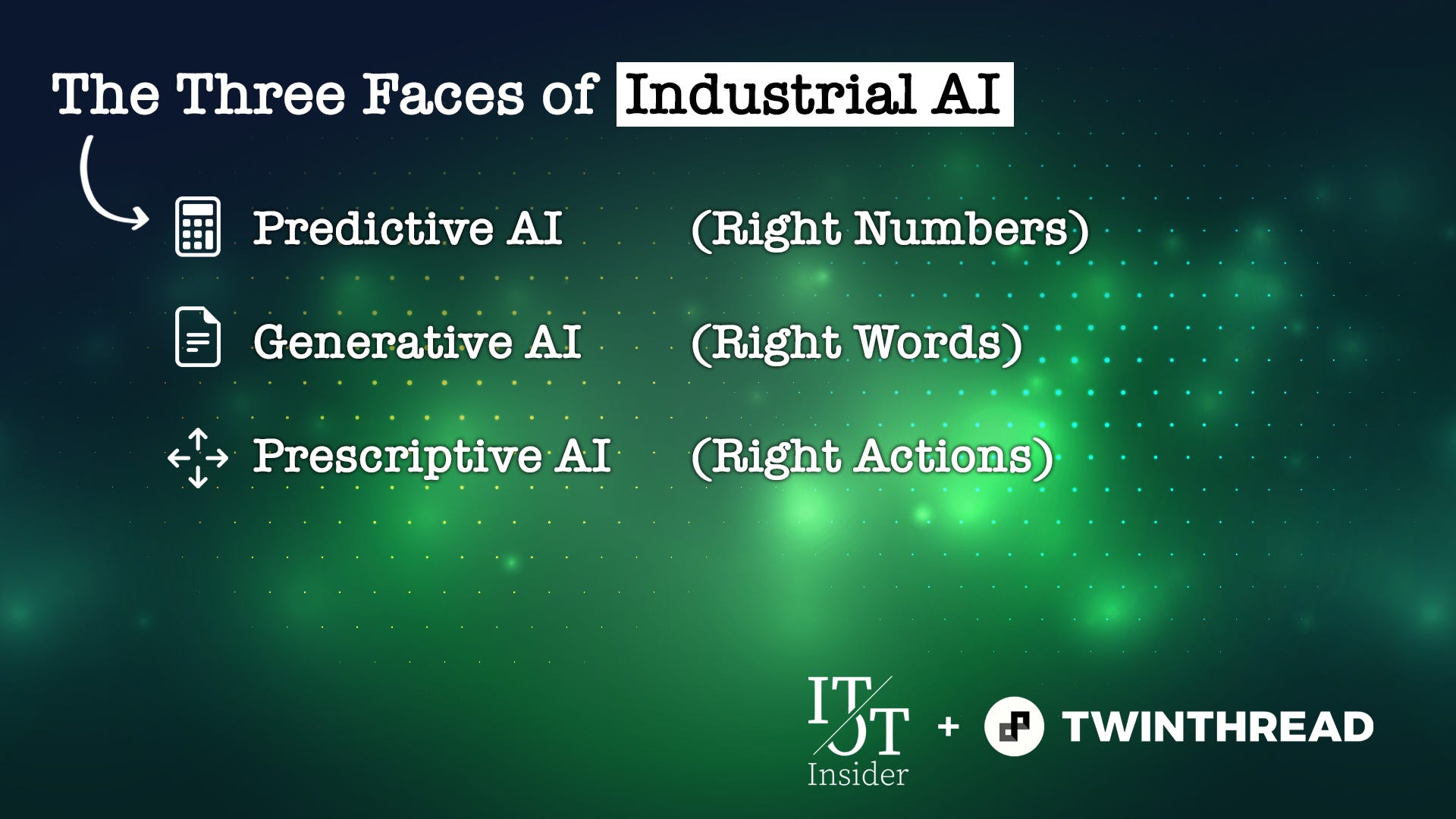
To make sense of AI in industry, we like to break it down into three categories:
Predictive AI,
Generative AI,
Prescriptive AI.
Or in simpler terms:
Right Numbers,
Right Words,
Right Actions.
1. Predictive AI (Right Numbers)
This is where AI directly touches your data and produces actionable recommendations, typically using some form of Machine Learning, Computer Vision etc.
Think:
Predictive maintenance (reducing downtime)
Golden batch analysis (ideal recipes or setpoints)
Product disposition (deciding good vs. bad product)
Predicting operating conditions and efficiency improvements
The ROI here can be very tangible. For example, in food & beverage, reducing moisture content by just 1% can save millions EUR/USD per year. In heavy industry running a big plant sub-optimally can easily cost 100,000 EUR/USD per hour.
Or take this example from TwinThread:
The problem: CPG manages 450+ data centers with 650,000 assets and 20 million sensors. Traditional monitoring relied on static thresholds: if voltage or temperature crossed a line, alarms went off. That worked at small scale — but across hundreds of thousands of assets, it became chaos. Too many false alarms, missed issues, and not enough experts to keep up.
The predictive leap: Using TwinThread’s platform, CPG built a Virtual Operations Center with more than 750,000 AI models. Each model learns the unique aging pattern of an asset type or configuration. Instead of a blunt threshold, the AI continuously predicts how each asset will degrade under different conditions. Suddenly, technicians could see which assets were aging faster, which ones posed real risk, and when failures were likely to occur. This shift turned a noisy reactive system into a predictive one — cutting false positives and extending asset life.
Predictive AI is built for those use cases: optimizing numbers that directly translate into money.
2. Generative AI (Right Words)
This is the area where most of the hype currently lives. Generative AI is about working with language, documents, and unstructured data. But there is also quite some misconception about what GenAI is really good at.
Before we dive into what this means for the Industry, we came across a brilliant recent survey by Atlassian where they asked 3,000+ developers how they use GenAI (besides helping with the actual coding). The result was:
Searching for information
Testing
Documentation
Automating workflows
Chatting / sparring with AI to refine thinking
That’s an interesting insight — but what does it actually mean in an industrial context? In our conversations with TwinThread, the most promising takeaways were:
Searching through manuals and technical documents and summarizing them,
Assisting engineers with coding or configuration (for example in developing SCADA screens, configuring tools, etc),
Labeling and cleaning messy data sets (Excel, CSV, sensor logs),
Creating insights in natural language (e.g. “Why did this line stop last night?”).
But there are some challenges: hallucinations and the lack of understanding of the dynamics of the physical twin, just to name a few. And even if the AI produces great recommendations, engineers often don’t have time to act on them. So the potential value comes less from the AI itself and should come more from how it’s integrated into actual workflows.
3. Prescriptive AI (Right Actions)
Prescriptive AI is the “last mile” of AI: it doesn’t just analyze, it takes action.
That can mean starting a production run with optimal parameters, adjusting setpoints to hit a target, choosing the best line and dispatching operators, or even creating work orders and notifying technicians based on detected patterns.
It sounds exciting — and it is — but in industrial settings it raises tough safety and security questions. Should AI directly control production, or should it limit itself to suggestions and low-risk tasks like draft work orders?
In fact, we already have tried and tested closed-loop systems like Model Predictive Control (not to be confused with the brand new Model Context Protocol used in AI applications). The difference is that Prescriptive AI relies on reasoning models, often remote, which feed recommendations back into control systems. The optimization goals, however, are still set by humans — and handing those over to AI remains a step too far.
That’s why failsafes and guardrails are essential, from the system level down to the control layer. With discipline, Prescriptive AI can safely extend what closed loops already do.
And yes — your agents are here too. Not as a standalone solution, but as the execution layer that orchestrates these actions across different AI types.
Let’s go back to CPG’s data center use case. We already described what this means from a predictive AI point of view. But let’s go one step further…
Towards prescriptive: But prediction alone isn’t enough. The value only materializes when AI insights drive action. In CPG’s case, the VOC doesn’t just warn about anomalies (like a UPS battery trending towards thermal runaway). It ties the alert to prescribed actions: which technician to send, when to intervene, and how to adjust operating conditions. This is the step toward Prescriptive AI — orchestrating workflows around predictive signals.
The lesson: Scaling Industrial AI isn’t about one magical model. It’s about building the pipeline from prediction → prescription. TwinThread shows that once AI is embedded into daily workflows, it doesn’t just prevent downtime; it gives operators foresight, stretches expert capacity, and creates room for strategic planning years in advance.
(there is more to read below the image)
Building the Business Case
When it comes to AI, the business case doesn’t start with “we need AI.” (well, we hope it doesn’t, but unfortunately it does for many people…)
It starts with the use case.
The use case defines what kind of data you need and what business value you’re trying to unlock.
For Predictive AI, the ROI is often straightforward. You optimize a setpoint, you reduce downtime, you predict failures before they happen. Those savings show up on the bottom line. It’s often easy to draw a straight line between model outputs and financial outcomes.
For Generative AI, things get trickier. The value is less about direct cost savings and more about productivity and efficiency. GenAI tools reduce engineering hours, make documentation easier, speed up troubleshooting, or cut down the time needed to configure systems. That’s valuable, but it’s not as simple to quantify. Think of it like bookkeeping in the era of spreadsheets: before Excel, bookkeeping was manual and slow. With Excel, bookkeepers didn’t disappear, but they could do far more in the same time. Productivity went up, even if the ROI calculation was less obvious.
And then there’s the tipping point. With AI, the first wins are often small. Maybe the tool saves an engineer a few hours a week, or helps a maintenance team avoid one bad call. That’s not “gold” yet. But if you persist, those small nuggets accumulate. Over time, they add up to big efficiency gains and major competitive advantages.
A final thought
So here’s the takeaway:
Not all AI is the same, and not all AI delivers the same kind of value.
Predictive AI is about optimizing numbers.
Generative AI is about making sense of words.
Prescriptive AI is about taking the right actions.
Each has its place.
Each comes with challenges.
Together they give us a framework where AI can actually deliver ROI in industry.
As we’ll continue to explore in this series: it’s not about waiting until your data is perfect. It’s about starting with real use cases, applying the right kind of AI in the right context, and scaling safely.
About TwinThread
TwinThread has developed the world's first Industrial Cloud Platform, combining Industrial AI and digital twins with no-code/low-code development tools. This enables operations teams to maximize the value of their existing legacy systems and data. Teams can rapidly innovate with pre-built solutions specifically designed to optimize equipment, processes, and supply chains. Our customers achieve best-in-class productivity and efficiency by empowering frontline workers with groundbreaking AI technology. With over 1 million digital twins, nearly 50 million sensors, and 2 million AI models deployed, TwinThread has a proven track record of delivering scalable Industrial AI that maximizes return on investment.
At the IT/OT Insider we do value our independence and transparency. So as we look for ways to pay the bills we were looking for ways to work with sponsors without giving up on those principles. This is where the idea of sponsors comes from. Together with a few selected sponsors we’ll explore some topics that we both find interesting in the same way we write our normal articles. In the coming weeks you’ll find a couple of pieces that have been sponsored. Feel free to contact us if you are interested in a partnership as well.
Just a great 👍 insightful read!
The predictive & prescriptive AI definitions are confusing. Prescription, by definition, should mean recommendation. They both need each other to make an impact. Also, there's a lot of overlap. Based on the prediction, the prescription is generated. I am personally in favour of not using these terms. What do you think?