


(Our topic, Our tone, Sponsored by Litmus.io1)
If you’ve worked in manufacturing long enough, you know the stories. The PowerShell script someone wrote five years ago that nobody dares to touch. The Excel sheets living on an unpatched FTP server. The new packaging line that came with its own locked-down data silo. The M&A deal that suddenly dropped a whole new tech stack on your lap.
We’ve all been there.
When a line goes down, engineers do what we’ve been trained to do: whatever it takes to get things running again. Mix-and-match some tools, hack together a workaround, and move on. It works in the moment — but over time, those quick fixes quietly pile up into silos, duplicate tools, and a ball of mud that makes scaling nearly impossible.
And here’s the thing: this isn’t just our observation. We’ve heard it again and again in our conversations with vendors — and especially from the team at Litmus, who we’ve been talking to regularly since the podcast we recorded with them earlier this year. They see the same mess across hundreds of manufacturers and have built their approach around tackling exactly these challenges.
That’s why in this article, we want to talk about consolidation: how to tame the entropy without killing experimentation, and how to scale without building the next spaghetti monster. And to make it concrete, we’ll share the five-step playbook that Litmus uses to keep things clean, repeatable, and ready for scale.
Balancing Entropy
Left alone, every system drifts into chaos.
Entropy is the default.
Engineers love their Excel sheets (and for good reason — they do exactly what you need, when you need it). But you can’t build a global data strategy on Excel. So how do you escape the spiral?
Do you rip everything out and start from scratch?
No chance. That’s too slow, creates resistance, and frankly kills experimentation (which often starts in spreadsheets or scripts anyway 😀).
Do you build a new layer on top?
Yes. But only if you can do it fast and well:
Fast means standardized rollout and a central team that sits close to both production and IT.
Well means defining the right governance to keep entropy in check.
Because the reality is messy:
Multiple vendors, each with their own tools.
Turnkey machines shipping with data locked inside.
A packaging line delivered last year that now needs reverse-engineering.
Or the merger that suddenly drops a brand-new plant into your lap, complete with an entirely different tech stack.
It can feel like the universe is actively working against anyone who wants to make data flow across the company. We’ve been there (many times). And we know you probably have your own war stories too.
And then comes the data model problem: Ask six people about their data model and you’ll get eight different answers.
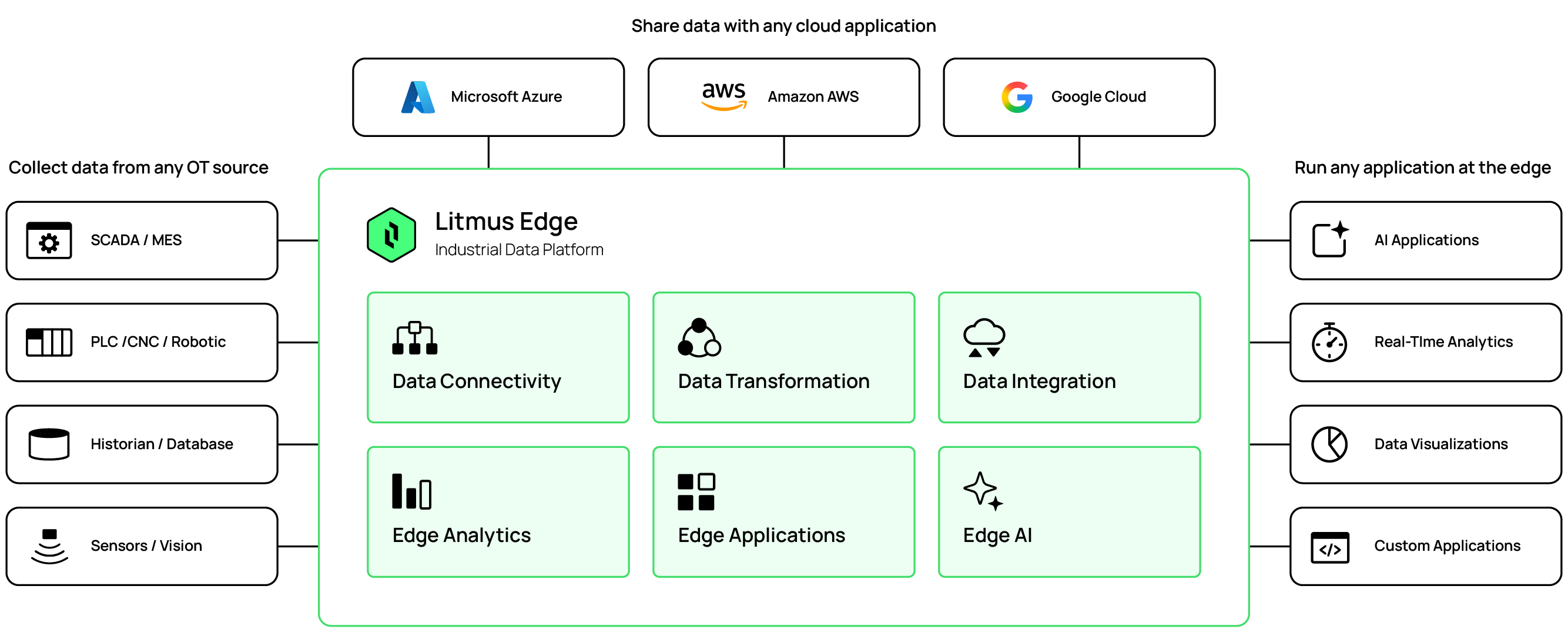
Our Industrial Data Platform Capability Map makes it clear: connectivity is just step one. The real battle is transforming, contextualizing, and structuring that data so it can actually be used consistently — by people, by applications, and increasingly by AI — without weeks of bespoke integrations per line.

Platforms are about scale, time-to-value, and repeatability, something the team at Litmus lives and breaths. Here is how they fit into the Capability Map:
Connect any device (capability 1)
We all know ripping and replacing isn't practical. That's why the Litmus platform connects to both legacy and modern OT devices out of the box (250+ drivers) and creates a consistent abstraction layer without breaking what works. They can plug into everything from decades-old PLCs to modern OPC UA machines in hours, not months.Add context to the source (capability 1+2)
Raw tags are useless without meaning. Litmus adds context at the edge—normalizing, modeling, and mapping data into a usable structure before it ever leaves the plant. They bake in context so downstream systems aren't flooded with noise, but with intelligence.Integrate with cloud & edge apps (capability 7)
Getting data out of the plant is only half the battle. Litmus makes it easy to share contextualized data northbound with enterprise systems, data lakes, and edge applications so teams can act on it everywhere they need to.Enable AI at the edge (capability 5)
Run AI directly at the edge, at scale. Manufacturers can run predictive maintenance, anomaly detection, and even GPU-optimized or small language models right at the edge—cutting latency, reducing downtime, and improving resilience where it matters most.Share data securely (supporting functions)
Scaling fast doesn’t mean cutting corners. Litmus ensures every data flow is encrypted and governed, so plants, clouds, and apps stay connected without compromising security or compliance.Deploy & scale with ease (supporting functions)
One plant is easy; 50+ plants is where things get messy. Litmus makes rollouts repeatable with central management and templates that keep deployments consistent across sites and regions.
5-step Playbook for a Painless DataOps Roll-out
A painless roll-out?
Sounds like a myth, right?
Everyone in this space has lived through at least one of those projects: over time, over budget, and with just about everyone unhappy at the end. It happens. But it doesn’t have to be that way.
The difference comes down to how you set things up:
Successful roll-outs are not about a big-bang deployment or endless firefighting. They’re about a motivated central team that knows both the business and the technology inside out, backed by a vendor whose solution is agile enough to handle the inevitable differences you’ll face across plants, lines, and systems.
And here’s the kicker: agility alone isn’t enough. You also need governance. Without the right guardrails, entropy creeps back in. The best vendors don’t just ship a product — they help you put the structures in place to keep your environment consistent, maintainable, and scalable long after the first deployment is done.
When we asked the Litmus team how they approach these challenges, they laid out a standard way of working that just makes sense. It’s not about chasing the newest tool or trying to architect the “perfect” system on day one. It’s about building discipline into the process so things can scale — without turning into yet another pile of technical debt.
Here is their playbook, step by step (continue reading below the picture):
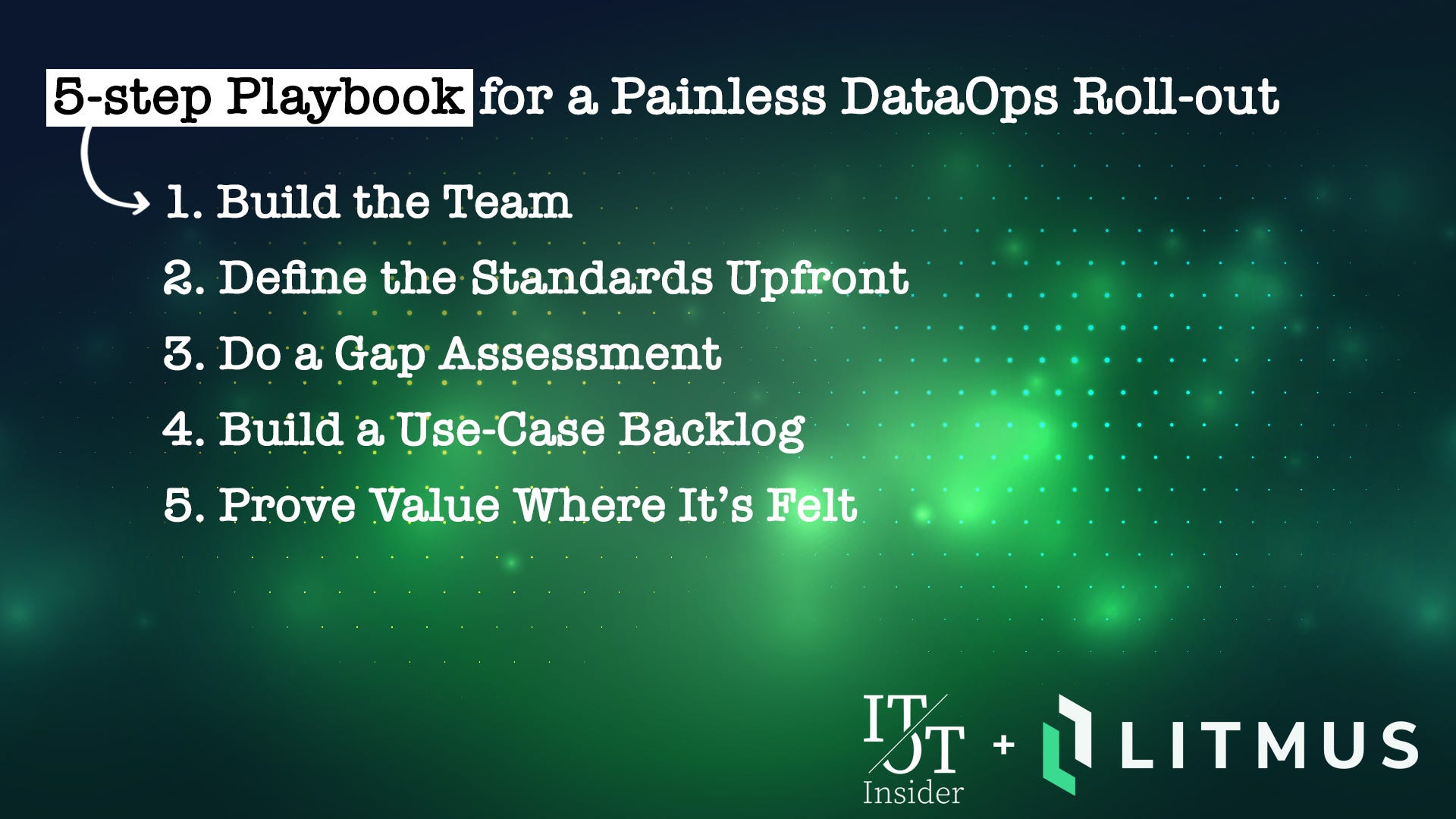
1. Build the Team
It all starts with people. The most successful companies have a central IT/OT team that stays close to the shopfloor while owning the bigger data landscape. And that landscape isn’t static. It’s a living map of systems, signals, and flows that someone actively maintains.
This team connects enterprise priorities to plant realities.
They do it with shared goals, not mandates. At plant level, named liaisons help bridge local needs with corporate strategy. And for larger companies, Centers of Excellence (CoEs) play the role of facilitators — they don’t pretend to be the smartest people in the room, but they make sure alignment and support are there.
2. Define the Standards Upfront
Before you pick tools, you need to know your standards. That means sitting down with cybersecurity and mapping edge nodes, data paths, and placement against Purdue. Decide what lives at L2, L3.5, or the DMZ, and define how things talk to each other.
Standards also cover infrastructure: what does a compliant host look like? Can you roll out a golden image with infrastructure as code? How do you handle secrets consistently? If you can’t stamp a site in hours, it won’t scale. And if you can’t automate the deployment, entropy wins.
3. Do a Gap Assessment
Next, compare what you have against what you need. Look for small gaps that can deliver quick wins. That means starting at the site that actually cares: the one hungry for better visibility, faster decisions, or fewer blind spots.
Map the existing stack against an Industrial Data Platform capability map. What stays, what consolidates, what retires? Prioritize the items that reduce toil (duplicate collectors, brittle transforms, endless manual exports) and boost data quality.
As we often say: “The most successful companies start with use cases that improve the day-to-day for the people who’ll live with the system — not just the ones that look good in a corporate dashboard.”
4. Build a Use-Case Backlog
Every use case has explicit data requirements. Define what signals you need, in what context, with what latency and retention. Who at the plant benefits from this use case? If the answer is “nobody,” it won’t pull.
One caution here: if you let every site design its own architecture, you’ll quickly end up with as many solutions as you have plants — plus the maintenance burden. The backlog must stay centralized, but it should always be grounded in the reality of the shopfloor.
5. Prove Value Where It’s Felt
Finally, show results where they matter most. Don’t start with a massive enterprise dashboard that nobody at the plant looks at. Start with the low-hanging fruit: daily standups, first-hour decision-making, simple blind spot elimination.
Our conversation with John Younes

Closing thought
At the end of the day, scaling isn’t about chasing shiny tools or designing a “perfect” architecture on paper. It’s about codifying how you work and making that standard so easy to roll out that the path of least resistance is also the path to scale.
That’s why the playbook matters. Build the right team, define your standards, map the gaps, align on the use cases, and prove value where it’s felt. Do that, and you give people reasons to pull — not push — for the next step.
Vendors like Litmus can be a strong fit here because they’ve seen the mess across hundreds of manufacturers and know how to balance agility with governance. But the real hero isn’t the vendor. It’s your standard, your capability map, and your people.
And don’t forget: momentum beats mandates every time. When the value shows up in daily standups, in fewer blind spots, in decisions made faster and with more confidence, that’s when the pull begins. That’s how entropy gets pushed back, and that’s how scale actually happens.
At the IT/OT Insider we do value our independence and transparency. So as we look for ways to pay the bills we were looking for ways to work with sponsors without giving up on those principles. This is where the idea of sponsors comes from. Together with a few selected sponsors we’ll explore some topics that we both find interesting in the same way we write our normal articles. In the coming weeks you’ll find a couple of pieces that have been sponsored. Feel free to contact us if you are interested in a partnership as well.